It’s easy to let our mood sink to the level of our circumstances.
Movies do this intentionally. They pull us into fear, tension, excitement, or hope. Our nervous systems follow the story, almost without asking.
Life works the same way.
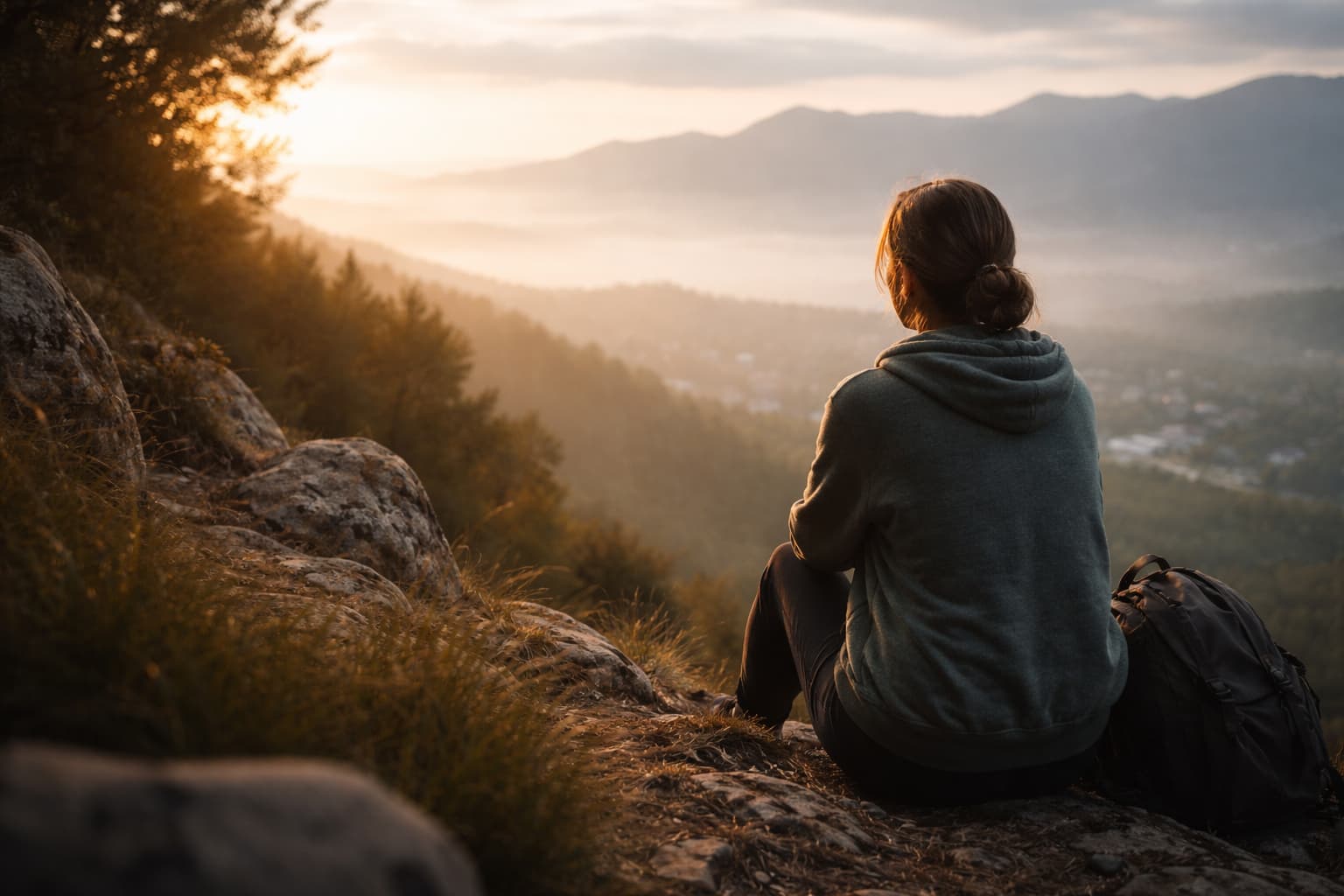
Our moods shape how we see the world. When things are going well and we’re on a kind of emotional high ground, we tend to see farther. Opportunities feel visible. Problems feel solvable.
When we’re low — in a valley — our vision narrows. Everything feels heavier. Perspective gets distorted. It’s easy to get stuck in a negative loop.
And it’s easy to postpone gratitude or happiness until something changes.
“When I have more money, I’ll be happy.”
“If I had a better job, things would be different.”
“When this season passes, then I’ll feel better.”
I’ve learned — sometimes the hard way — that this doesn’t really work.
I’ve been fortunate to be in beautiful places, places people would call paradise. But if someone is grumpy, they’re usually still grumpy there. If they’re angry, they’re still angry.
The location changes.
The mood doesn’t.
That’s when this idea started to click for me.
The skill is learning to be the kind of person you want to be now — not later.
Not once something improves. Not once something is achieved.
Now.
You’ve probably seen this in other people. No matter what life throws at them, they seem to come out steady. Not untouched — but upright.
I think of it like a fishing bobber. Waves hit. The line gets tugged. But it doesn’t stay underwater for long. It rises back to the surface.
They’ve learned not to let their attitude sink to the bottom when life struggles — which it inevitably does.
Some people seem to come with that club already in their bag. It’s part of their temperament. Others of us have to go out and buy that wedge and practice with it.
Either way, it’s a skill.
At a practical level, mood can be trained, just like anything else.
One of the most powerful tools I’ve found — and one I haven’t mastered — is gratitude.
No matter what my circumstances are, I can express gratitude. And when I do, something shifts. Contentment increases. Perspective widens. My mood lifts in a way that’s hard to replicate any other way.
I learned this during a season of undiagnosed autoimmune issues. There were moments when I felt overwhelmed, exhausted, and deeply discouraged. Still, I worked — sometimes awkwardly, sometimes forcefully — to give thanks for the countless things my body was doing right.
It wasn’t pretty. But it mattered.
The price of gratitude is effort — and it’s available to everyone.
Retraining the brain takes work. It has to be intentional.
Personally, I like doing mood work in the morning. I take a few minutes and pay attention to where I’m at. Sometimes I’ve even rated my mood before and after.
My goal is simple: raise my state and bring my best self to the surface.
I list things I’m grateful for and try not just to think them, but to feel them. Sometimes that happens quickly. Sometimes it takes real effort. But I’ve noticed that the more I practice, the longer I tend to stay in a better state.
Just as someone can learn bitterness or resentment through repetition, a person can learn gratitude and joy through intentional practice.
I know this isn’t easy.
You might be sick.
You might be stuck in a job you don’t like.
Your spouse might frustrate you.
Your kids might not listen.
None of that disappears because you choose a better mood.
But waiting until life is perfect before allowing joy isn’t a workable strategy either. We all know that.
Life isn’t all sunsets and roses. And waiting to be happy until it is means we miss most of the journey.
Finding joy in the journey — while we’re in it, scraping and climbing through the ups and downs — is how we get the most out of this thing we call life.
And that’s the invitation.
Rise above the noise.